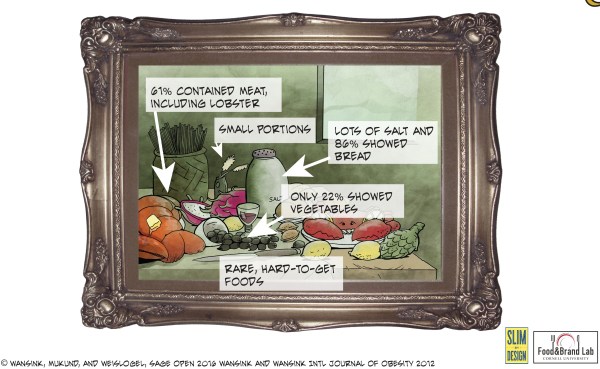
Food porn is the glamourised or spectacular visual presentation of cooking or eating. Typically images feature foods that are high in fat and calories, exotic dishes that arouse a desire to eat or the glorification of food as a substitute for sex.
Why do tropical plants have such big leaves?
Leaf size and shape is incredibly important to plants, as it helps them cope with the environments in which they live. We’ve long known that plants in the tropics have larger leaves than those in cooler climes (see image above of one of the world’s biggest leaves from tropical Borneo – the Giant elephant ear plant), but the reason for this has been hotly debated. We now think we know why…
Continue reading “Why do tropical plants have such big leaves?”
Where does your food come from?
I’m not talking here about which supermarket or grocery you shop in, or whether your food was grown locally or comes from overseas, but rather where the crop plants we eat were first discovered and developed as food. Now that we can pretty much eat whatever we want, from wherever we want, whenever we want – do you know where the food you eat first evolved and originated from?
The Agtech revolution is here
Science fiction and futurists visions (e.g. Brian D. Colwell) commonly depict robots running agricultural production, for example, automated farm harvest machinery in the film Interstellar.
Innovation for food
Over the last few years, food production and processing have been embarking on the biggest change since the industrial revolution. Novel approaches that exploit robotics, machine learning, computer vision, epi-genetics and gene editing technologies are being used to improve the efficiency and cost-effectiveness of food production.
Food waste is a big global issue
The United Nations Food and Agriculture Organisation (FAO) has estimated that a third of all food produced globally is wasted, that’s 1.3B tonnes.
To put that in context, the Great Pyramid at Giza weighs about 5 million tonnes. If that were food waste it would weigh about 1.4 million tonnes (because food is less dense than stone), so the amount of food waste produced globally is equivalent to just less than 1000 Great Pyramids of Giza.
That’s a lot of food.
Publish but don’t perish
Highly collectable species, especially those that are rare and threatened, can be put at risk from poaching if information describing there location is published. But rather than withholding this information, scientists should publish such data through secure portals so that this knowledge can be used to help conserve and manage the world’s most threatened species.
Forests hiding in plain sight
A new global analysis looking at the distribution of forests and woodlands has ‘found’ 467 million hectares of previously unreported forest in dryland ecosystems – a land area equivalent to 60% of Australia. In this day and age of advanced remote sensing how are such discoveries still possible?
My, what big teeth you’ve got…
We may have been able to tame the dog – the only large carnivore to now happily coexist with humans. But how does domestication occur and can we learn from it to develop new animal breeds and crop varieties for food?
Science can identify illegally logged timber – so lets start implementing
Science can identify the source of timber and verifying legality. So it should be a simple case to apply the science to new international legislation that aims to limit illegally logged timber in global supply chains. Well not quite, the application of science requires detailed understanding of the timber industry and supply chain dynamics.
Continue reading “Science can identify illegally logged timber – so lets start implementing”